Calm Focus: Get More Done Without Stress

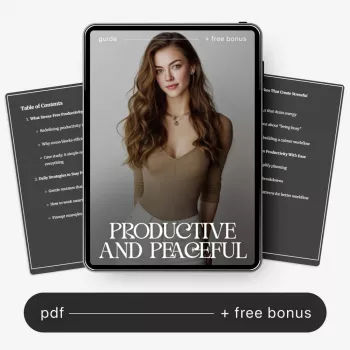
Productive and Peaceful: A Mindful Efficiency & Focus Guide for Getting More Done Without Stress
Being productive doesn’t have to feel like a race against the clock. A calm approach to focus uses fewer willpower battles and more simple systems: clear priorities, short planning, gentle attention training, and recovery built into the day. With the right rhythm, work moves forward while your nervous system stays steady—and you still have enough left to fully stop when the day ends.
What “productive and peaceful” actually looks like
Productive and peaceful isn’t “always on.” It’s consistent progress on meaningful tasks with low mental friction, even on ordinary days. The goal is reliability—showing up with a calm pace—rather than pushing constant intensity.
- Define the outcome: steady progress and completed deliverables, not nonstop urgency.
- Choose a calm pace: fewer open loops, fewer context switches, and more protected single-task time.
- Measure success by three signals: finished work, stable energy, and a mind that can actually power down after hours.
- Swap perfection for clarity: done today beats ideal someday; refine later during scheduled review time.
When your day is designed to reduce cognitive load, it naturally becomes easier to focus. That lines up with what’s known about stress and the body—chronic stress strains both attention and recovery (American Psychological Association).
A low-stress focus setup in 10 minutes
A calm start doesn’t require a total life overhaul. It requires a repeatable “landing pad” that tells your brain: this is what we’re doing next.
- Clear to essentials: one tab, one document, one notebook page for the next task.
- Choose one focus cue: a specific playlist, timer sound, or drink—use the same cue to begin.
- Reduce decisions: write the next physical action (example: “draft 10 bullets,” “reply to 3 emails,” “open the file and outline”).
- Set a minimum win: a small finish line that prevents avoidance and builds momentum.
- Preempt interruptions: enable Do Not Disturb, silence non-urgent notifications, and park distractions on a sticky note.
This setup works because it removes the most draining part of productivity: constant choice-making. It also helps you avoid multitasking traps, which reliably degrade performance and increase mental scatter (Harvard Business Review).
Mindful efficiency: focus cycles that don’t drain you
Trying to “power through” for hours tends to backfire. Mindful efficiency uses short focus cycles plus intentional resets so attention stays stable instead of brittle.
- Work in cycles: 25–45 minutes of single-task focus, then 3–10 minutes to reset (walk, stretch, breathe).
- Use soft focus when stuck: relax your gaze, slow your breathing, and return to the next tiny action rather than forcing a breakthrough.
- Add a transition ritual: close tabs, capture loose thoughts, then choose the next task before starting.
- Batch reactive work: messages and admin belong in scheduled windows to protect deep work.
- End each cycle with a one-line log: what moved forward + what the next step is; this lowers re-entry stress later.
Simple daily rhythm: calm productivity plan
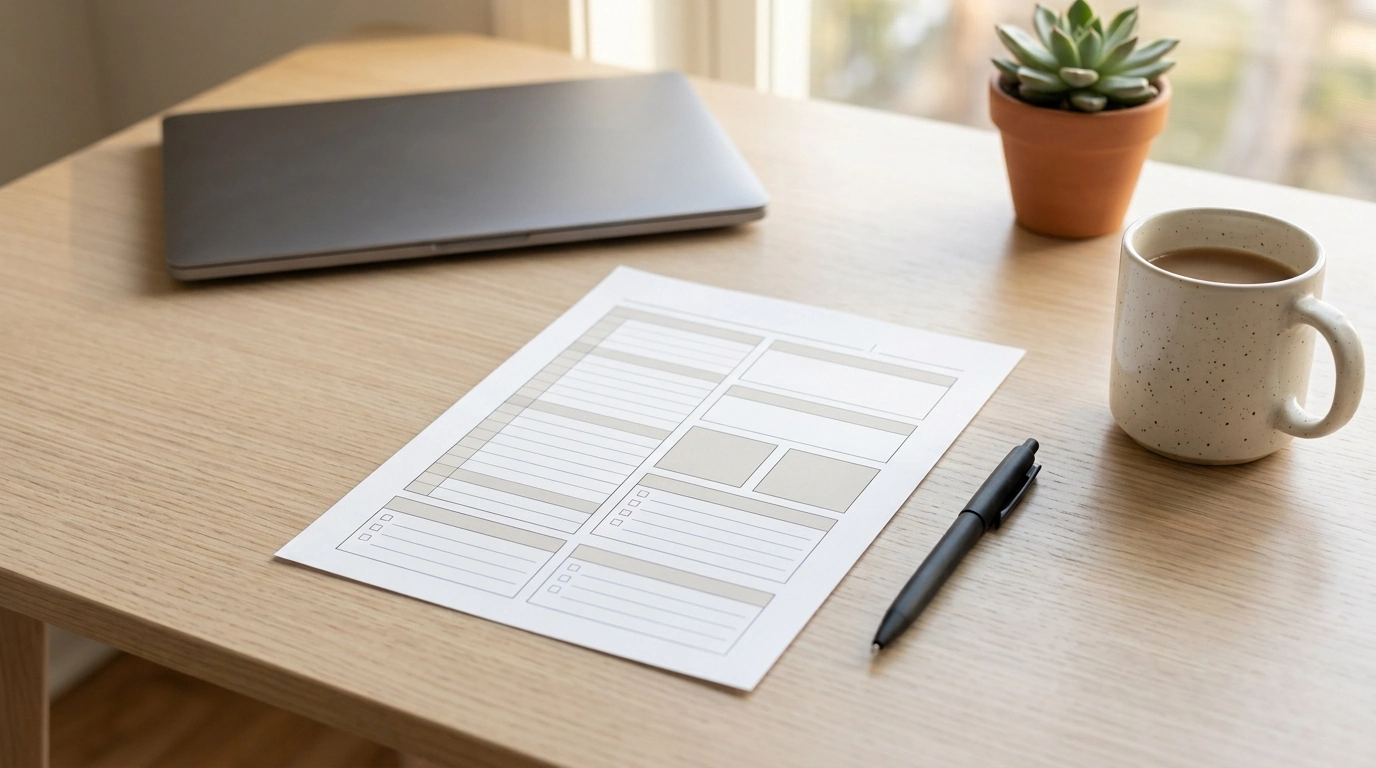
| Time block | Goal | How to keep it peaceful |
|---|---|---|
| Start of day (5–10 min) | Pick 1 priority + 2 supporting tasks | Write the next action for each; delete or defer everything else |
| Focus block 1 (25–45 min) | Deep work on the priority | Single tab, timer, phone away; stop at the timer even if mid-sentence |
| Reset (3–10 min) | Recover attention | Move the body, hydrate, 6 slow breaths, quick sunlight if possible |
| Reactive batch (15–30 min) | Handle messages/admin | One inbox at a time; stop at the end even if unfinished |
| Focus block 2 (25–45 min) | Second deep work push | Return to the written next step; no “just checking” online |
| Close-down (5–10 min) | Clear mind for the evening | Capture loose ends, choose tomorrow’s first step, tidy workspace |
Stress-proof prioritization: doing less, finishing more
Quick calm techniques for anxious productivity
Building a repeatable system (so discipline isn’t doing all the work)
- Create an attention budget: decide how many deep work blocks fit your real day; protect them like appointments.
- Weekly review (20 minutes): check progress, prune commitments, and pick next week’s top outcomes.
- Design the environment: make distractions harder to reach than the tools needed for your priority task.
- Use one capture tool: one place for thoughts and to-dos reduces mental clutter and open loops.
- Make recovery non-negotiable: sleep, breaks, movement, and downtime are part of productivity—not a reward for it. Poor sleep reliably harms attention and mood (NIH).
A guided approach for mindful efficiency and focus
If you want a structured, step-by-step routine with prompts and exercises, use Productive and Peaceful | Mindful Efficiency & Focus Guide | How to Stay Productive Without Stress. It’s built to help you set priorities, run calmer focus cycles, and close down your day without carrying mental noise into the evening.
For days when self-criticism or fear of getting it wrong slows you down, pair it with How to Learn and Grow from Mistakes – Digital Guide—a practical way to reduce perfection pressure and keep improving without spiraling.
FAQ
How can productivity improve without relying on constant motivation?
Rely on systems that reduce decisions: a short daily plan, written next actions, protected focus blocks, and an environment that makes distractions inconvenient. When the next step is obvious, you don’t need to “feel ready” to start.
What should happen during breaks so they actually restore focus?
Do something that lowers stimulation and resets the body: a brief walk, stretching, water, or slow breathing—ideally off-screen. Avoid switching into fast scrolling, which keeps attention fragmented and makes re-entry harder.
How many priorities are realistic for a single day?
One main outcome plus one to two supporting tasks is realistic for most days. Too many “must-dos” increases stress, encourages multitasking, and often results in less actually finished.









Leave a comment