Decisive Living: Stop Overthinking, Choose With Confidence

Confident Choices: A Simple Guide to Decisive Living
Decisions shape days, relationships, and momentum. When choices feel heavy—because of perfectionism, fear of regret, or too many options—simple decision skills can restore clarity. Decisive living isn’t about forcing certainty; it’s about making reasonable calls, taking the next step, and learning quickly without turning every outcome into a personal verdict.
Why decisions feel hard (and why that’s normal)
Even “small” choices can feel draining when the brain is juggling limited time, imperfect information, and social pressure. A few common reasons show up again and again.
- Overload: Too many options create fatigue, which can lead to avoidance or impulsive picking. Research on decision fatigue has explored how repeated decision demands can reduce mental energy over time.
- Perfection pressure: Believing there is one “right” choice turns everyday decisions into high-stakes events.
- Fear of regret: Attention narrows to what might be lost, rather than what can be gained or learned.
- Identity stakes: Choices can feel like a verdict about competence, worth, or the future.
- Unclear values: When priorities are fuzzy, every option feels equally risky, so nothing stands out as “good enough.”
It also helps to remember that human decision-making is naturally bounded—limited by time, information, and cognitive bandwidth—an idea often discussed as “bounded rationality.”
A simple framework for decisive living
Decisive living works best as a repeatable loop, not a one-time burst of motivation. Use this lightweight framework to shrink a big, foggy choice into a few clear actions.
- Name the decision in one sentence using a verb (e.g., “Choose a workout plan,” not “Fitness”).
- Set a time horizon (“good for the next week/month/season”) to prevent over-optimizing.
- Choose three criteria that matter most (time, cost, health, learning, relationships, peace of mind).
- Limit options to 2–4; park the rest on a “later” list to reduce mental clutter.
- Decide, then commit to a review window so you learn from results rather than replaying the choice.
| Step | What to do | Helpful prompt |
|---|---|---|
| 1. Clarify | Write the decision in one line and the deadline | “What am I deciding, by when?” |
| 2. Prioritize | Pick 3 criteria that matter most | “If I could only optimize three things, which?” |
| 3. Narrow | Cut to 2–4 viable options | “Which options are realistic this week?” |
| 4. Choose | Select one option and define the first action | “What’s the next 10-minute step?” |
| 5. Review | Evaluate after the set window and adjust | “What did this teach me for next time?” |
Tools to stop overthinking in the moment
When the mind is spinning, a quick decision tool acts like a brake—short, direct, and usable under stress.
- The 70% rule: When you have enough information to make a reasonable call, act. Waiting for 100% clarity often adds delay without improving results.
- The two-way door test: If the decision is reversible, decide faster and treat it like an experiment.
- Regret minimization: Picture life a year from now. Which option best reduces long-term regret?
- Opportunity cost check: Ask what you’re sacrificing by delaying (time, energy, focus, goodwill).
- One-sentence commitment: Write a short statement you can stand behind: “I’m choosing X for the next month because it best supports A, B, and C.”
Make decisions that match values (not moods)
Moods push for immediate relief; values support long-term stability. When you define values in concrete terms, decisions get simpler because “aligned” options become obvious.
- Define top values with behaviors: “Health = 3 workouts/week” or “Family = dinner together 3 nights/week.”
- Use a future-self filter: Choose what the future version of you would thank you for, not what ends discomfort fastest.
- Separate preference from principle: Preferences can flex; principles keep you steady.
- Create default rules for repeats: “Sleep before screens,” “If unsure, choose the simpler plan,” or “If it takes under 2 minutes, do it now.”
- Track small signals: Note energy, stress, and alignment after choices to spot patterns worth repeating.
Over time, these aligned decisions strengthen self-efficacy—the belief that you can take effective action—which is closely tied to consistent follow-through.
Confidence after the decision: follow-through and self-trust
Many people don’t struggle with choosing as much as they struggle with the aftershocks: second-guessing, rumination, and the urge to reopen the decision. Confidence grows when you close the loop.
A guided practice for the next 7 days
Digital guides to practice decisive living (and stick with it)
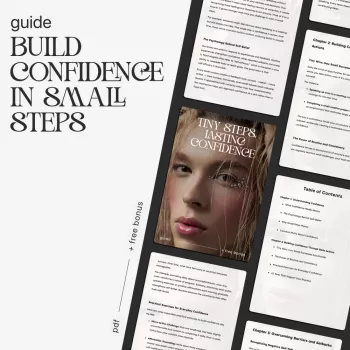
- Confident Choices: A Simple Guide to Decisive Living (digital self-growth guide) keeps the process simple with prompts you can reuse for work, relationships, and personal goals.
- How to Learn and Grow from Mistakes (digital guide) supports the review step—so outcomes become learning instead of a reason to spiral.
- 18K Gold Custom Alphabet Initial Necklace can act as a daily cue—one small, physical reminder of the person you’re practicing becoming (steady, clear, and committed).
Helpful sources for deeper context
- National Library of Medicine (PMC): Decision fatigue
- Stanford Encyclopedia of Philosophy: Bounded Rationality
- APA Dictionary of Psychology: self-efficacy
FAQ
How can decision-making become easier when anxiety is high?
Use a short time box, reduce options to 2–3, apply the two-way door test, and pick one small next action you can complete quickly. Add a brief, scheduled review window so your mind doesn’t keep reopening the decision all day.
What if the fear of choosing wrong keeps coming back?
Write down why the choice was reasonable with the information you had at the time, then set a planned date to reassess. Treat outcomes as feedback, not proof that you “can’t decide,” and return your focus to the next step.
How do decisive people build confidence over time?
They rely on a repeatable process, keep small promises consistently, and review results calmly to learn. Confidence grows from steady follow-through and learning cycles, not from never making a mistake.











Leave a comment