Beat Procrastination: Micro-Starts, Time Blocks, Weekly Reset

Procrastination Proof: Simple Systems for Lasting Focus, Motivation, and Time Management
Procrastination rarely comes from laziness—it usually comes from unclear next steps, emotional friction, and environments that make distraction the default. The most reliable fix is a set of small, repeatable systems that reduce resistance, clarify priorities, and protect deep work time. Below is a practical framework to start finishing what matters—without relying on willpower.
Why procrastination keeps winning (and why willpower isn’t the answer)
Procrastination is often emotion management: avoiding discomfort, uncertainty, or fear of not doing something perfectly. When a task feels vague (“work on the project”) or risky (“what if it’s bad?”), the brain searches for fast relief—usually something with instant reward like notifications, browsing, or busywork.
Ambiguity creates delay because unclear tasks don’t trigger action. Decision fatigue makes it worse: too many choices about what to do first and how to begin pushes you toward the easiest option. A workable strategy focuses on reducing friction—shrink the start, simplify choices, and build momentum on purpose. For more on the psychology side, the American Psychological Association’s resources on procrastination are a helpful overview.
The “Start Small” protocol: micro-commitments that create momentum
Starting is the bottleneck. Once movement begins, motivation often follows. Use a “2-minute entry ramp” by defining a tiny first action that is impossible to fail: open the document, write one sentence, put your materials on the desk, or title a new note.
Next, set a “minimum viable session” (MVS): commit to 10 minutes of work before deciding to stop. Most days, the hardest part is the first minute; after that, continuing becomes easier. Lower the bar on the first draft—aim for “rough and real,” not “ready to submit.” If you notice inner resistance, pair action with a simple script: “Just start for 10 minutes; quitting is allowed after.”
Finally, track starts, not just finishes. A “start streak” builds identity and consistency because it’s easier to maintain than a perfect completion streak. The goal is to become someone who begins—finishing becomes a natural byproduct.
Make priorities obvious: one outcome, one next step
When everything matters, nothing moves. Pick one primary outcome for the day: the single result that would make the day feel successful. Then convert that outcome into a next action—something physical and visible (send three emails, outline section 1, book the appointment).
A useful test: if it takes more than 30 seconds to describe, it’s not a next step. Break it down until it becomes a clear action that can be started immediately. To reduce repeated decision-making, batch planning once: spend 10–15 minutes writing your daily plan so you aren’t renegotiating priorities all day.
To protect focus without losing ideas, keep a “Not Today” list. When a new task pops up, write it down and return to the primary outcome. This keeps your attention from becoming a revolving door.
Time-blocking that actually works (even with low motivation)
Time-blocking works best when it matches your energy, not just your schedule. Put demanding tasks in your highest-alertness windows and save low-energy windows for admin. Use short focus cycles (25/5 or 45/10) to prevent mental fatigue from turning into avoidance, and add transition buffers (5–15 minutes) so one delay doesn’t collapse the whole plan.
Focus Block Templates (pick one and repeat)
| Template | Work | Break | Best for | How to use it |
|---|---|---|---|---|
| Quick Sprint | 25 min | 5 min | Getting started, short tasks | Do 4 cycles, then take a longer break |
| Deep Work | 45 min | 10 min | Writing, analysis, studying | Silence notifications; define one deliverable per block |
| Gentle Ramp | 10 min | 2 min | Low motivation days | Commit to 3 rounds; stop only after the third |
Design an environment that makes focus the default
Handle procrastination triggers: fear, perfectionism, and overwhelm
Use the “ugly first pass” rule: prioritize quantity first and quality second. Editing is much easier than creating from nothing. If overwhelm is the trigger, add a constraint: “What can be finished in 15 minutes?” or “What is the smallest proof of progress?” For behavior change tactics that pair well with this approach, implementation intentions (clear if/then plans) are a proven tool; see James Clear’s summary here.
A simple weekly reset to keep progress from slipping
A guided option for building a repeatable focus system
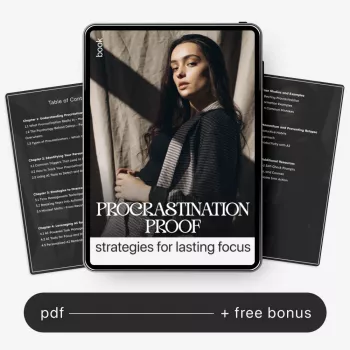
- Procrastination Proof: Strategies for Lasting Focus | How to Overcome Procrastination eBook | Digital Productivity Guide for Focus, Motivation & Time Management (Digital eBook)
- How to Learn and Grow from Mistakes – Digital Guide | how to grow from mistakes Mindset, Self-Growth & Resilience eBook for Personal Development (Digital eBook)
Under the surface, procrastination is often a form of “akrasia” (knowing what to do but not doing it). If you want a deeper philosophical backdrop, the Stanford Encyclopedia of Philosophy entry on akrasia is a solid reference.
FAQ
How long does it take to stop procrastinating?
Small improvements can happen immediately when tasks are defined as clear next steps and distractions are made harder to access. More stable change typically takes a few weeks of consistent starting rituals, simple time blocks, and a weekly review to keep the system from drifting.
What if procrastination is caused by anxiety or perfectionism?
Use reversible first steps (outline, draft, sketch), time-box the work, and separate creating from editing so the first pass can be messy. If anxiety is severe or persistent and affects daily functioning, professional support can be a practical next step.
Which method is better: to-do lists or time-blocking?
Lists are best for choosing what matters; calendar blocks are best for actually doing it. A simple hybrid works well: pick three priorities, convert each into a next action, then schedule focus blocks with small buffers.











Leave a comment