Build Real Confidence with Tiny Steps You Can Repeat

Tiny Steps, Lasting Confidence: A Practical Guide to Building Real Confidence in Small, Repeatable Actions
Lasting confidence rarely shows up all at once. It’s built the unglamorous way: by making small choices you can repeat, even on low-energy days, until your brain has enough proof that you can handle what you say you’ll do. The goal isn’t a permanently “confident mood.” It’s dependable self-trust—created through clear actions, tracked outcomes, and gradual exposure that doesn’t overwhelm your nervous system.
What “lasting confidence” really is (and what it isn’t)
Lasting confidence is best understood as self-trust: evidence gained from completed actions. When you consistently follow through, you develop what psychology calls self-efficacy—your belief that you can execute behaviors needed to produce results (see the APA definition of self-efficacy).
It’s also not the same as:
- Self-esteem: your overall sense of worth.
- Motivation: the emotional “push” to do something (which naturally rises and falls).
Confidence feels unstable when progress is untracked or your goal is too vague—like “be confident.” A simple rule helps: raise difficulty only after consistency is established. If the habit isn’t steady, the challenge is probably too big.
Start small: the tiniest step that still counts
The fastest way to stop overthinking is to define a minimum viable action—a step so small you can do it even when you don’t feel ready. Think in the 2–10 minute range. That range is short enough to reduce procrastination and long enough to create momentum.
Choose one domain to begin so your brain gets clean, repeatable “wins”:
- Social
- Work/skills
- Body/health
- Boundaries
- Creativity
Then convert goals into behaviors. Replace “be confident at work” with “spend 5 minutes outlining the next task.” Replace “be more social” with “send one friendly message.”
Small-step examples that build confidence
| Confidence area | Minimum step (2–10 min) | Next step (10–20 min) | Proof to record |
|---|---|---|---|
| Social | Send one friendly message | Invite someone to a short coffee | Message sent / invite made |
| Work/Study | Outline one task on paper | Complete the first 20 minutes | Outline done / timer completed |
| Body/Health | Put on workout clothes | 10-minute walk | Clothes on / walk finished |
| Boundaries | Draft one sentence to say no | Deliver the boundary calmly | Draft written / boundary stated |
| Creativity | Open the project file | Create one rough version | File opened / draft created |
Use micro-wins to create a feedback loop
“Proof” matters because the brain updates beliefs when it observes outcomes repeatedly. The key is to track completion, not perfection: Did you show up? Did you finish the step? That’s the win.
- Record proof in one line: “Sent the message.” “Walked 10 minutes.” “Drafted version 1.”
- Use a neutral reward: a checkmark, a 2-minute break, one song—something repeatable that doesn’t create pressure.
- If a step fails, shrink it: don’t quit the system. If “10 minutes” fails, do 2 minutes. If “send a message” fails, write the message and save it.
Shift the inner script: growth-minded self-talk that stays realistic
Confidence gets stuck when your self-talk becomes global and permanent: “I’m not confident.” Swap labels for specific observations: “I avoided that call today.” This keeps identity flexible and makes the next action obvious.
Use “not yet” language to stay honest without collapsing: “I’m not comfortable speaking up… yet.” This aligns with a growth mindset approach (see Carol Dweck’s work at Stanford).
Thought swap sheet
| Common thought | More accurate replacement | Action that matches the replacement |
|---|---|---|
| I always mess up. | I’ve made mistakes and I can improve with reps. | Do one practice rep and review. |
| They’ll judge me. | Some people may judge; many won’t, and I can handle it. | Say one sentence and pause. |
| If it isn’t perfect, it’s pointless. | Done is data; progress comes from iterations. | Submit a version 1 draft. |
| I’m not confident. | Confidence grows when I keep promises to myself. | Complete today’s minimum step. |
Build confidence through exposure—without overwhelm
If anxiety is a major driver, skills-based tools like cognitive behavior therapy can help you challenge thoughts and practice new behaviors (see the APA definition of CBT).
Make it stick: routines that protect consistency
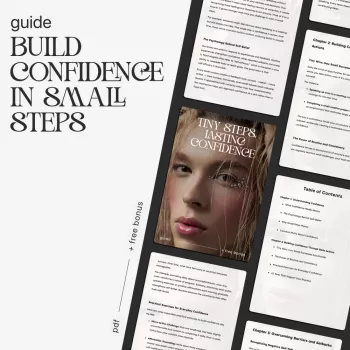
A guided option for daily practice: Tiny Steps, Lasting Confidence (PDF)
For a structured, printable/digital approach, Tiny Steps, Lasting Confidence | Digital Guide on How to Build Confidence in Small Steps | Self-Growth & Mindset PDF is designed around repeatable actions, proof tracking, and simple routines that hold up on low-motivation days. It pairs well with a confidence ladder: pick one area, start tiny, repeat, then level up.
To support a growth-minded routine when things don’t go perfectly, How to Learn and Grow from Mistakes – Digital Guide can help you turn slip-ups into usable feedback instead of a reason to quit.
For a small confidence “anchor” you can wear daily, a personal piece like the 18K Gold Custom Alphabet Initial Necklace can serve as a steady reminder of your identity goals (especially helpful when practicing boundaries or social exposure).
When confidence struggles may need extra support
FAQ
How long does it take to build confidence with small steps?
Expect weeks, not days. Confidence rises as you accumulate repeated proof from completed actions, so the timeline depends on how consistently you practice and how specific your steps are.
What if tiny steps feel too easy to matter?
Easy is the point at first because consistency builds identity. Level up after 3–5 repeats by increasing difficulty about 10%—slightly longer, slightly bolder, or with one added constraint (like doing it sooner).
How do you build confidence if you’re afraid of judgment?
Use a gradual exposure ladder and keep most practice in the 3–6 discomfort range. Focus on process goals (practice one sentence, ask one question) and use a simple script like: “Quick question—could you clarify one thing?”











Leave a comment