Printable Social Confidence Checklist for Any Situation

Social Confidence in Any Situation: A Printable Checklist for Calmer, Clearer Conversations
Social confidence is less about being naturally outgoing and more about having reliable steps to lean on when nerves show up. A simple, repeatable checklist can help with everyday conversations, networking, small talk, and speaking up—without overthinking every moment. When your body is tense and your mind is racing, structure is calming: you don’t have to invent the “right” move on the spot—you just follow the next step.
Stress and anxiety can also feel very physical (tight chest, shallow breath, shaky hands). If that sounds familiar, it can help to understand what’s happening in the body and why simple tools like breathing and grounding work so well. The American Psychological Association explains how stress affects the body, and Harvard Health Publishing outlines how breath control can reduce the stress response.
What “social confidence” looks like in real life
- Feeling grounded enough to start (or join) a conversation without spiraling into self-criticism
- Staying present while talking instead of rehearsing the next line in your head
- Handling awkward moments with a quick reset rather than shutting down
- Asking questions, listening, and sharing a little about yourself in a balanced way
- Leaving conversations with less rumination and more clarity about what went well
Notice that none of these require a “big personality.” They’re practical behaviors—small, repeatable actions that make social moments feel safer and more predictable.
Why a checklist works when confidence feels unreliable
- Reduces decision fatigue by turning “What do I do?” into a short sequence of actions
- Creates consistency across different settings (work, friends, dates, events)
- Builds small wins: repeating a few doable behaviors is how confidence compounds
- Helps shift attention outward (curiosity, listening, context) instead of inward (self-monitoring)
- Makes progress trackable: what was tried, what helped, what to adjust next time
Even when anxiety shows up mid-conversation, a checklist gives you something concrete to do next—often the fastest way to stop the “I’m messing this up” spiral.
Quick reset: a 2-minute pre-conversation routine
Use this right before you walk into a room, hop on a call, or approach someone new. The goal isn’t to eliminate nerves; it’s to lower the volume and give yourself a steady starting point.
- Body: unclench your jaw, drop your shoulders, and place both feet on the ground for steadiness.
- Breath: inhale for 4 seconds, exhale for 6 seconds, for 5 rounds to lower tension.
- Intent: pick one simple goal (for example, “Ask two questions,” or “Share one detail about my week”).
- Opener: choose a safe first line—context-based comment + question works in most settings.
- Permission: allow imperfect delivery—clarity and warmth matter more than perfect timing.
If anxious feelings are frequent or intense, it may also be helpful to learn about anxiety symptoms and support options from the National Institute of Mental Health.
Conversation moves that make interactions easier
Think of these as “conversation steering wheels.” You don’t need all of them; you just need one or two that feel natural so you can keep the interaction moving without forcing it.
Common situations and the most useful checklist focus
| Situation | Most helpful focus | Example line |
|---|---|---|
| Meeting someone new | Context + curiosity | “How do you know the host?” |
| Networking or work events | Clear intro + value + question | “I’m in marketing ops—what projects are you working on right now?” |
| Group conversations | Listen for an entry point | “That’s interesting—what happened next?” |
| Awkward silence | Reset + new thread | “Quick question—have you tried any good places around here lately?” |
| Disagreeing politely | Validate + boundary + curiosity | “I see your point. For me it’s different—what makes you feel strongly about it?” |
After the conversation: build confidence without overanalyzing
Printable support: Social Confidence in Any Situation (digital download)
If you want a clear, portable structure you can use again and again, the Social Confidence in Any Situation printable checklist (digital download) is designed for quick reference before, during, and after an interaction. Keep it on your phone/tablet or print it and carry it—especially helpful for practicing calm openers, follow-up questions, and graceful exits.
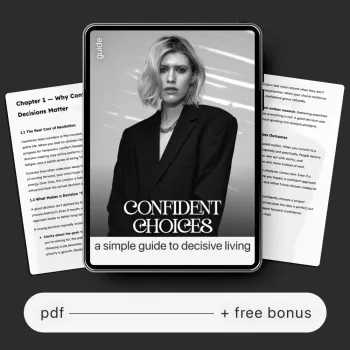
To strengthen the “after” part of the checklist—turning awkward moments into learning instead of self-criticism—pair it with How to Learn and Grow from Mistakes – Digital Guide. Together, they support both the real-time skills and the mindset that keeps confidence growing.
If you like having a small personal “anchor” at events (something that quietly reminds you to stand tall and speak clearly), a simple accessory can help you feel more put-together. The 18K Gold Custom Alphabet Initial Necklace is an easy, everyday piece that can act as a subtle confidence cue without distracting from the conversation.
FAQ
Is this checklist helpful for introverts?
Yes. It’s built around low-pressure, repeatable steps that support authentic communication, energy management, and small realistic goals—without requiring you to “be outgoing” to do it well.
How fast can social confidence improve with a checklist?
Many people feel immediate relief from having a clear structure. Lasting confidence usually builds over days and weeks as you repeat a few key behaviors and track small wins across multiple interactions.
What if anxiety spikes in the middle of a conversation?
Try a quick reset: feel both feet on the ground, slow your exhale, and ask a simple question to shift focus outward. If you need to leave, use a graceful exit like, “It was good talking with you—I’m going to step out for a moment.”










Leave a comment